Friday, February 13, 2009

A Note About Demons:

  Before coming to South America, I had spent a good amount of time around religious functions in the U.S. and even studied at the Elkhart seminary.  However, I must admit that though I had heard talk at these functions of demons sent to plague good Christians and entice others into all other sorts of diabolical acts, I was still highly skeptical of their existence.

  No longer.  I have been in Paraguay for four months now, and one thing I can say for certain is that demons do exist.  In fact, the remains of one of thier ilk is splattered on the wall in front of my computer as I write to you.  Now, I am trying not to diminish the other-worldy aspect of these encounters by talking so crudely about one's demise, but the imps do seem to be somewhat more common here.  

  For example, it is a rather weekly occurence to kill upwards of twelve to fifteen demons in the shower.   (I was surprised to learn that they seem to like humid places where they can breed others... I had always assumed that fire was involved.)  You may think me brave, but I still need to bathe, so one of us has to go.

  If you have never seen a demon, let me describe its common form and habit.  It has wings that make an irritating high pitched sound like an over-worked food processer when it's trying to whisper sweet subversive nothings in your ear.  It is nearly impossible for a novice to determine from whence it came and wherefore it is going.  That means it's fast.  It also would like nothing more than to suck a mortal human's blood.

  The news media here has even picked up on the existence of these other-worldy forms, commenting the other night that they carry something called Dengue Fever.  I can only assume that this is some sort of curse that hampers the physical and mental faculties of the victim.  The expert on the program suggested burning an incense to ward off the evil presence, but Krista and I have yet to see any demons really driven off by Raid Country Fresh.


Thursday, January 29, 2009

The Relativity of Life

I never really thought I'd have a rooster wake me up in the morning, and then I moved to Paraguay. The rooster and it's adolescent sidekick start at about 6am with their first round of wake-ups. The full call first by the grown, followed by a pathetic attempt by the younger. Think 14 year old boy voice meets chicken and you'll get close enough to the sound we hear every morning. Their calls drift in our chicken wire screened in window, that opens up from our bedroom into the walled in backyard. Morning has come.

Breakfast is normally bread with a jam, a small sandwich, or yogurt. But whatever we eat, we always have the same thing to drink. "Cocido", a hot tea made fresh from the dried leaves every morning with a touch of sugar and milk. Perfect in my book. Berta always says, "if cocido was beer, you'd be drunk all day long!" And then she does this great imitation of a drunk stumbling around on the streets, it's one of my favorite of her many imitations.

Slowly but surely, Berta is becoming more and more acustom to us washing the plates. Yes, the spickets are a little different here. We have a pvc pipe that runs straight to the sink with a little plastic turn top. No option for hot water, but I've yet to see a dirty plate, nor have I gotten sick from any of the little germs looming around on the dishes.

Showering time is quick, not because we don't have good access to water, but because it's cold! Most of the time a cold shower is welcomed, however, we do have cool mornings, and wet dreary days were it is not such a blessing. However, there have been very few times that we have not been able to shower.

A few days ago Berta went to visit a old friend of hers that she hadn't seen in a long time. When she returned she said she wanted to cry. The house was bursting at the seams with 7 people living in a tiny 2 room home. The house was filthy, with no running water, nor electricity. Berta said for their meal today they had a mixture of toasted flour, with a little water and sugar added. They had hardly enough to get by, and too much shame to go out of the house. It was then she told me, "We are NOT poor. It may seem that way sometimes, but we are not."

It was a friend of mine in college that told me, "life is a constant state of relativity." And it's true. Craig and I are comfortable where we are. Yes, things are different than at home, but we are not poor here. Poor is relative. We look at Donald Trump and say we don't have enough in middle class Goshen, IN. We look at Goshen, IN and say we are poor in Paraguay, but there is always someone, somewhere surviving on less. The challenge presents itself then, how can I live simply, so that others may simply live?

Thursday, January 15, 2009

What's New...


So Krista and I took a little trip to the Argentine capital of Buenos Aires, and were thus out of contact for a while, but here are some posts that were written while we were away.  History of Paraguay Part II is up, as well as a Christmas video and Krista's Christmas reflections...  Pictures should be up shortly as well in our photo album.  If you forgot, the link is over on the right --->

Wednesday, January 14, 2009

Christmas Wishes

The traditions seen in Paraguay were much different, and there was little "Christmas season" to be seen, except during the few days before Christmas Eve, however, it was still a wonderful day spent with family and friends. Preparations are made for food, the "tatakua" (outdoor oven) is heated, little gifts are wrapped, "clerico" (wine, cider, and fruit salad) is mixed, and the outdoor eating area is decorated.

It was while we were hanging the outdoor lights that I said, "I just can't believe that it's Christmas! It's too hot!" They replied, "It seems like Christmas to us, because it is hot!"


True, we didn't have an advent service, caroling, Christmas trees, or a baking extravaganza. Christmas music was even difficult to find until the 24th of December. All of these things were going against every inclination that I had of Christmas, but nevertheless, Christmas passed the Paraguayan way, and our remembrance of little baby Jesus coming to earth was still the same.

(There was one minor change. For the first time, the household of Berta [our host mother] saw snow during the Christmas party. Wanting to help in some way, I remembered the 3rd grade art project that every child learns- how to make snowflakes. Thank you Mr. Fiely, I had snow on Christmas Eve and everyone enjoyed it, even saying, "How much time did it take to cut all of those little holes?".)
The food was baked in the tatakua, garlic chicken, pork, and sopa paraguaya, which is similar to a corn bread. There were four different types of cold salads which Berta's daughter brought. To drink Paraguayans wouldn't think of having just water for any halfway special occasion, so we had Coca-cola, Sprite, Fanta, clerico, and cider. The family and friends, 16 in total, started arrived at 9:30pm. Slow, steady eating, and good conversation was only interrupted during the midnight run of fireworks from the neighbors, as if to announce to all that in fact Christmas had arrived. (Silent night, holy night, all is calm, all is bright...Paraguay got the clue with all is bright- the sky right? Once they set off the fireworks. But I think the other phrases of the song were lost in the Paraguayan postal system- it's horrible if you haven't heard already.)

The cake was cut once people concluded that they could not eat anymore, and coffee was served for everyone. It wasn't until around 2:30am that people returned to their homes, to continue their own tradition of sleeping through Christmas Day. Once the dishes were finished, we crawled into bed, only to wake up to a knock on the door from Berta saying that it's time for lunch. Berta confessed she had only just woken up also, and immediately after lunch, we all returned to bed. All in all, that was our Christmas day, nothing fancy, just a day to recover from the previous late night.

My first Paraguayan Christmas really was wonderful, and it was a treat to experience such an important holiday in another country. So I hope all of you enjoyed your Christmas, with all the traditions that bring Christmas to life. Merry Christmas to everyone!!

Monday, January 12, 2009

History of Paraguay, Part II: "Polygamy vs. the Cow Head"


The saga continues...


Early Spanish Paraguay

  Around 1539, something crazy happened in Asunción.  King Carlos V of Spain wanted a govenor to oversee the new colony, and a man by the name of Domingo Martínez de Irala took up the offer.  Irala had already been adventuring around Paraguay for a couple of years and must have eaten some multi-colored frog.  I say this because, lo behold!, Irala had the crazy idea of working alongside the local Guaraní people instead of killing, enslaving, or robbing them.  This turned out to be a decent strategy because, with their powers combined, the Spanish and the Guaraní were able to ward off stronger war-like peoples from the North and learn to work together on agricultural projects and the like.

  A side effect of all of this peace and goodwill between new people-group friends was that a few started have too much goodwill.  The Spanish explorers, who had left behind the other gender of their race in Spain, began to notice that some of the Guaraní girls were pretty cute.  This of course led to babies.  Before you knew it, the two cultures had combined rather thoroughly physically as well as socially. (Even to this day, the ethnic make-up of Paraguay is very proudly, and significantly, as they call it mestizo, "mixed".  This is an important sociological concept for later on.) 

Cometh the Cow Head

  Things seemed to be going well with the racially and socially integrated society under Irala when, inexplicably, the Spanish crown decided it needed a new head in Paraguay.  So they sent Álvar Núñez Cabeza de Vaca (no, that is not a joke, look it up.  And I am pretty sure that there is no other translation besides "Cow Head").  Gov. Cow Head came higly touted.  A war hero and general famous person from Spain, CH tried to tie the budding city more closely to Madrid and refine morals to fit more closely to European standards.  Unfortunately, he did not take note of the high rate of Spaniards who already had a couple of Guaraní wives, not to mention kids.  

  Polygamy had served the Spaniards well too- Guaraní culture pays high respect to blood ties, and marrying into a Guaraní family meant protection, but also that your girl's brothers would show up during harvest time to help you bring in the crops.  Now, no one wants to give up free family labor just because some cow head wearing a fluffy collared shirt from Madrid says you have to give up wives 2,3, and 4.  

  The Spaniards living in Asunción were no different, and poor old Álvar found himself on the 25th of April 1544 first in a Paraguayan prison, and then on a ship "headed" back to Spain.  For the time being, Paraguay was safe from cow heads.     

Saturday, December 27, 2008

Feliz Navidad!


I'm pretty sure we explained what was going on to Berta before hand but, it is what it is...
(Here´s a little translation, "eso que es" means, "what is this".) Enjoy.


Merry Christmas,
Craig and Krista

Saturday, December 20, 2008

History of Paraguay... Part 1 "Stick a Flag in it."


  Well dear readers, I promised you a discourse on Paraguayan history, and you'll probably end up getting more than you paid for.  

  I started my research at the library of the Mennonite Seminary close by my house.  Unfortunately, this soon turned sour because it seemed that, at the seminary at least, nothing had happened in Paraguay since a Mr. Werner Redekopp chronicled a few details back in 1962.  Suspecting that perhaps things had happened in this country since that book was published fourty-six years ago (and no, I was not going to read Gilbert Franz's "Reise durch Paraguay" and consider it objective history), I asked around at a couple friends' homes and finally discovered "Historia del Paragauy" published by the esteemed Oceano Group.  Really, I know nothing about them, but it seems from their fine cover art that this Spanish firm knows its Paraguayan history. (If there was one thing that I learned after two years as a Goshen College History major, it is that you should always, always judge a book by its cover.)  On with the history:

The Guaraní

  Surprisingly, (at least to the European adventurers) Paraguay did exist, at least in its geographic form, before the Europeans started showing up at the beginning of the 16th century.  There is some debate as to how long humans have lived in South America, but the majority of evidence suggests that people have been leaving things buried in the Paraguayan soil for anywhere between 10,000 and 40,000 years.  Three major cultural groups or periods are suggested to have existed prior to 1500 AD, and the latter of these three, the Guaraní, are the people that the Spanish encountered when they started to show up without a dinner invitation.


  The Guaraní that inhabited Paraguay (in fact, they were all over central-South America) were a very organized society, with a combination of agriculture, gathering, hunting, and communal living helping to sustain a decent population.  That and polygamy.  The people had extensive knowledge of the "natural science" of their surroundings, and books chronicling their healing remedies exist in Paraguay to this day.  The Guaraní were also polytheistic, holding belief in a number of gods that would control different parts of the natural cycles.  (There are actually parallels of Judeo-Christian stories within the Guaraní religious lore, but they are more likely attributable to the influence of Catholic missionaries blending the old, for example, creation stories, with the new Christian version.)        

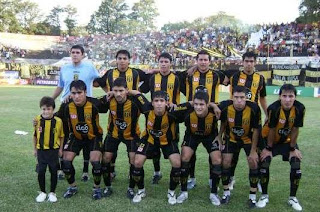
(Modern Guaraní warriors... the club really is named after the people)
  
  But, "without a doubt" say the folks at Oceano Group, the lasting impact of the Guaraní culture on this history of Paraguay is the contribution of the Guaraní language (I would like to insert the "that and polygamy" phrase again here... you will understand when you read the next installment).  From my time in Paraguay, I have read a number of different statistics that indicate how many people still speak this ancient tongue, but suffice to say that the lowest estimate that I have so far encountered said that 87.5% of Paraguays are fluent in Guaraní, with other estimates ranging as high as 99%.  This explains, dear reader, why I can tell you, "Che aipota tembi'u heta tereí". "I want good food."  I learn the basic survival needs first.

The Spanish

  Ah, the Spanish.  I'm sure many a young Mennonite got lost during sixth grade in daydreams of adventuring with Cortez, Pizarro and the other conquistadores to the New World in search of glory and gold.   Of course, to later learn that they basically killed, enslaved, or robbed everyone they met may have thrown something of a moral wrench into the dream, but it was a fine one nonetheless while it lasted.

  When speaking of the Spanish explorers who ended up near Paraguay, the story seems to be somewhat repetitve, which is nice when trying to write summaries 500 years or so later.  Basically, an explorer (for example, Sebastián Gaboto) gets a mandate from Carlos V, King of Spain, to go and take possesion of the land in what is now South America for the Spanish crown.  You know, stick a flag in the ground, build a fort, "civilize" the people you find, and Presto! the land is yours.  However, upon arrival, our explorer catches gold fever and tries to set out on some wild expedition into the interior of South America to look for treasure.  


  Unfortunately, one of these wild goose chases did turn up something under the leadership of Alejo García (credited with "discovering" Paraguay).  Mr. García managed to get the foothills of the Andes and pillage an Inca village.  He brought back some shiny metal, and then there was no stopping the Gold Rush of the mid-1500s.  

  However, another common theme of the Spanish adventures was that whatever explorer did manage to make some sort of name for himself inevitably wound up dying at the hands of an angry indigenous mob (Mr. García learned this lesson in 1525).  It may have had something to do with the killing, the enslaving, or the robbing.  Perhaps two of the three or the whole package.  It is hard to say, some folks get angrier easier than others.  But it is sufficient to note that no one who came, at least for the first while, ended up hanging around very long.    

  Finally though, after a couple disasterous preliminary expeditions, the Spanish did manage to make it up the Paraguayan river and set up a fort under the leadership of Juan de Salazar de Espinosa.  They christened the new domecile "Nuestra Señora de la Asunción" in 1537. 

Look for the second installment of "History of Paraguay": "Polygamy vs. the Cow Head"